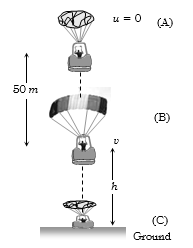
A parachutist after bailing out falls 50 m without friction. When parachute opens, it decelerates at 2 m/s 2 . He reaches the ground with a speed of 3 m / s . At what height, did he bail out ?
Text Solution
Verified by ExpertsA
After bailing out from point A parachutist falls freely under gravity. The velocity acquired by it will ‘ v ’
From 
 = 980
= 980
[As u = 0,  , s = 50 m ]
At point B , parachute opens and it moves with retardation of 2  and reach at ground (Point C ) with velocity of
For the part ‘ BC ’ by applying the equation 
 ,
,  ,
,  , s = h
⇒ ⇒  ⇒ ⇒
⇒ ⇒ 
⇒ ⇒ 
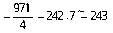 m.
m.
So, the total height by which parachutist bail out =  = 293 m.
Prepare Smarter with CGP Edu
Get practice questions, solutions, and test series in one place.
Write a Review
Share your experience with this question and solution.
Commentary
Send your comment, doubt, correction, or feedback to admin.
Similar Questions
Explore conceptually related problems